
Child Welfare

Strengthening Family Permanency Through Multisystemic Therapy
MST supports child welfare systems by reducing placements, strengthening caregivers, and addressing behavioral challenges in the home and community—helping families stay together and achieve long-term stability.
MST offers a suite of evidence-based models that support child welfare systems across prevention, intervention, and permanency.
Multisystemic Therapy (MST®)
Multisystemic Therapy (MST®) is the core evidence-based model on which all MST adaptations are built. It supports child-serving systems by addressing serious behavioral challenges through intensive, family- and community-based interventions that reduce placements and strengthen caregiver capacity.

MST for Child Abuse and Neglect (MST-CAN®)
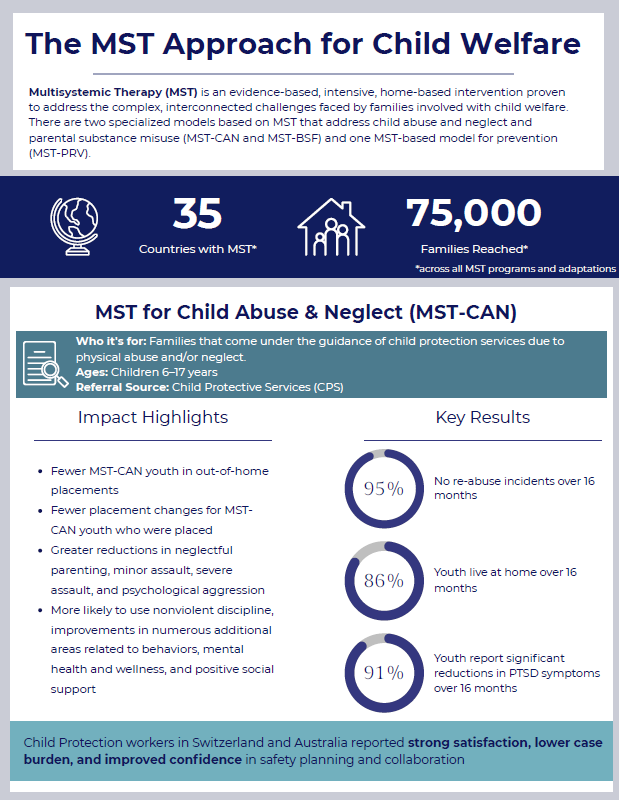
MST-CAN is designed for families involved in child protective services due to physical abuse or neglect. The model prioritizes child safety while addressing trauma, parenting skills, family functioning, and co-occurring challenges such as substance use and mental health needs, helping families safely remain together when possible. MST-CAN teams work intensively, often treating the needs of multiple family members, to address the complex challenges they face.

MST–Building Stronger Families (MST-BSF®)
MST-BSF supports families involved with child protective services where parental substance misuse and related risks threaten child safety. The model combines MST-CAN and reinforcement-based treatment approaches to reduce maltreatment risk, strengthen parenting, and prevent out-of-home placement for children.

MST–Intimate Partner Violence (MST-IPV®)
MST-IPV is designed for families involved with child protective services where intimate partner violence is associated with child maltreatment. The model focuses on improving safety, reducing violence, and strengthening family functioning while addressing related challenges such as trauma, mental health needs, and substance use. By working intensively in the home and community, MST-IPV helps stabilize families and support safe reunification when appropriate.

MST–Prevention (MST-PRV®)
MST-PRV focuses on adolescents involved with child welfare who are at risk of delinquency or deeper system involvement. The model emphasizes safety planning, family therapy, supervision, and coordination with child welfare systems to prevent placement and stabilize families before problems escalate.


Positive Outcomes for Child Welfare Systems
Reduced Risk of Child Maltreatment
MST and its adaptations help lower the recurrence of abuse and neglect by addressing safety risks, strengthening supervision, and improving family functioning—especially in families involved with child protective services.
Improved Child Safety and Caregiver Protection
Families build concrete skills to better protect children, manage crises, and respond safely to stressors, resulting in safer home environments.
Reduced Trauma Symptoms for Youth and Caregivers
MST-CAN, MST-BSF, and MST-IPV address trauma directly, helping youth and caregivers reduce trauma-related symptoms and improve emotional regulation and coping.
Stronger Parenting and Family Supervision
Caregivers develop stronger parenting practices, clearer boundaries, and more effective supervision, reducing behaviors that lead to system involvement.
Fewer Out-of-Home Placements and Re-Reports
By stabilizing families and addressing root causes early, MST adaptations for child welfare reduce the likelihood of placement, re-entry into care, and repeated CPS reports.
Prevention of Deeper System Involvement
MST-PRV and related models help prevent escalation into delinquency or prolonged child welfare involvement by intervening early and coordinating across systems.
Proven Results. Lasting Impact.
With over 90 studies and more than 140 peer-reviewed journal articles, Multisystemic Therapy features the largest body of evidence of successful interventions for high-risk youth.
Featured Resources
How to Become an MST Provider: A Comprehensive Guide
This guide will provide you with information on how to implement a successful program in your community.
Family-based Solutions for Child Abuse and Neglect
Read this report to learn how complex it can be to work with a family experiencing child abuse, neglect, or substance abuse, and the importance of family-based approaches such as MST-CAN.
Guide to MST and the Family First Act
Read more about the Family First Prevention Services Act (FFPSA), which allows states to fund evidence-based programs like MST, to prevent children from entering the foster care system.
MST Child Welfare Data Snapshot
An at-a-glance view of MST’s impact on child safety, provider wellbeing, and more.